Case Study · Events & Non-Profit
End-to-End Digitalisation of Samvaad (7th & 8th Editions)
End-to-end digital infrastructure for a large-scale tribal conclave—from registration to certificates.
 Tata Steel Foundation
1. Background & Context
Samvaad is a large-scale annual tribal conclave bringing together participants from diverse regions, backgrounds, and communities. The event involves multiple programs, sessions, meal schedules, and on-ground coordination across days.
Prior to Wooble Infotech's involvement, core event operations were handled through manual processes and loosely connected tools such as offline registers and basic Google Forms. While functional at smaller scales, this approach introduced operational risk, limited visibility, and execution bottlenecks as the event grew in scale and complexity.
For the 7th and 8th editions of Samvaad, Tata Steel Foundation required a reliable, unified digital system capable of supporting the entire event lifecycle—without increasing friction for participants who had limited exposure to modern digital tools.
2. The Core Problem
The challenge was not "building a website." The challenge was digitising a mission-critical, people-heavy event without breaking trust or usability.
Key issues with the earlier approach:
- Fragmented registration data across tools
- Manual attendance and access verification
- No real-time insight into meal consumption
- High dependency on human coordination
- Limited communication and engagement touchpoints
- Risk of on-ground confusion during live execution
For an event of this nature, failure at execution level was not an option.
3. Wooble Infotech's Mandate
Wooble Infotech was brought in to act as a digital operations partner, not a feature vendor.
Objective: Design and deploy a single, end-to-end event infrastructure that would:
- Be intuitive for first-time tech users
- Eliminate manual bottlenecks
- Provide real-time operational visibility
- Scale across multiple editions without friction
4. Solution Overview
The solution was designed as a layered digital system, covering the entire journey from registration to post-event certification.
A. Centralised Registration Portal
A dedicated event website was built to serve as the single entry point for all participants. Capabilities included: seamless participant registration, collection of structured participant data, selection of event sessions, meal preferences (veg / non-veg), time slots and participation options, and centralised data storage for organisers. This replaced scattered forms and manual data consolidation entirely.
B. Digital Entry Pass & Attendance Tracking
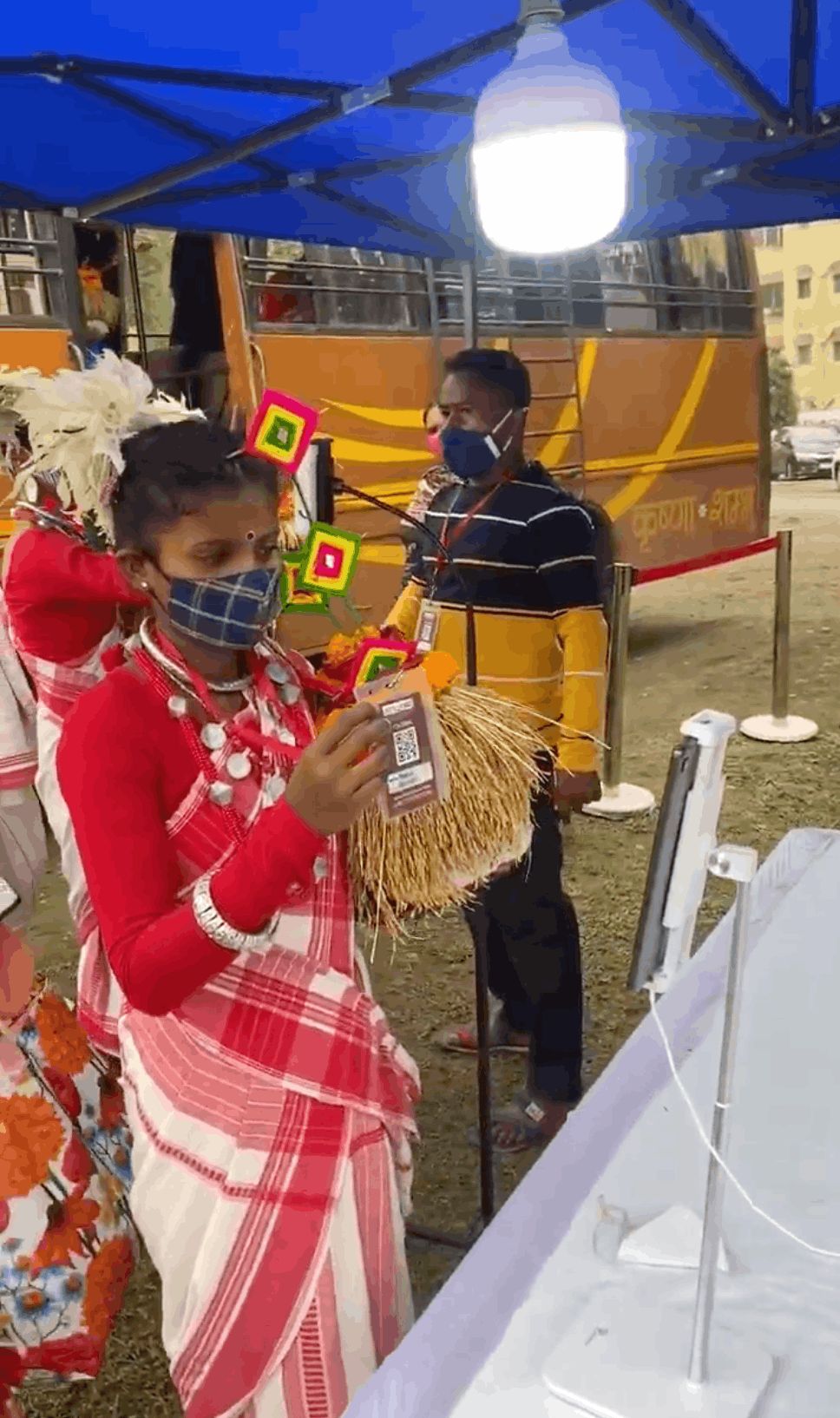
Each registered participant was issued a digital ID with a QR code. QR scanning at entry points automatically marked attendance, eliminated manual verification and paper passes, and enabled fast, error-free participant movement. This ensured accurate attendance records without slowing down entry flows.
C. QR-Based Meal Management System
The same QR code on participant ID cards was used at meal zones. Participants scanned their QR to access meals. The system logged veg / non-veg consumption and count per meal session. Outcome: real-time visibility into meal consumption, accurate planning for subsequent meals, reduced food wastage, and zero confusion at meal counters. This transformed meal management from guesswork into data-driven execution.
D. Event Monitoring & Live Communication
Event activities were monitored centrally. Live notifications were sent to participants when required. Email communications were scheduled and sent periodically: pre-event updates, session reminders, and important instructions. This significantly improved participant engagement and preparedness.
E. Automated Certificate Generation
Post-event, certificates were generated digitally, eliminating manual processing and follow-ups and ensuring timely delivery and record accuracy.
5. Execution Reality: The Real Test
A critical constraint was the user profile. Most participants came from tribal communities, had limited exposure to digital systems, and were unfamiliar with QR-based workflows.
Despite this: there were zero usability complaints. Participants were able to register independently, use QR-based entry and meals, and navigate the system without assistance. This validated the simplicity, accessibility, and robustness of the solution.
6. Outcomes & Impact
- Complete elimination of manual registration and attendance processes
- Centralised, real-time operational visibility for organisers
- Accurate meal planning based on live consumption data
- Improved participant engagement through structured communication
- Zero reported usability issues despite first-time tech users
- Successfully executed across two consecutive editions of Samvaad
7. Why This Matters
This project demonstrated that digital infrastructure does not need to be complex to be powerful. Wooble Infotech delivered a system that scaled across editions, a design that respected user context, and an execution model that reduced risk instead of adding it.
8. Wooble Infotech's Role
Wooble Infotech did not act as a vendor delivering isolated features. We acted as a digital operations partner, owning the event lifecycle from Registration → Execution → Insights → Closure.
This case study now stands as proof of event digitisation at scale, human-centric system design, and execution-first technology delivery.
Planning an event or need end-to-end digitisation? We specialise in custom event platforms and operational systems. Explore our software development and solutions.
See more case studies (healthcare, startup) or get in touch.
Get in Touch